The Pretentious Timepiece Guide
Published: April 22, 2026
Author: P. Dal Bianco

No one sought this guide.
Silence prevailed. Consent enough.
Very well. The rules.
Rule 1. A dress watch must be manual wind with hour and minute hands only. Small seconds at six is the lone indulgence. Anything more is costume jewelry masquerading as restraint.
Rule 2. Perpetual calendars may display a power reserve, but a seconds hand is an affront to its philosophical purpose. A watch that contemplates years has no business acknowledging seconds.
Rule 3. A utility watch must not host a date window lest it succumb to reliability drift and unintentional pantomime. A tool watch should not pretend to know how many days are in every month.
Rule 4. The Rolex Explorer II’s date function exists solely to track expedition days, and must remain incorrect unless set to Day One. If the date discrepancy is pointed out, the response must be, “I know.”
Rule 5. A dive watch achieves its proper form without a date. The most regrettable instance arises within the leisure of tropical shallows. Only there may the date be suffered for its rose gold bravado at the swim up bar.
A watch always has something to say. It signals status, priorities, and the side quests that shape a life. Its design should never cosplay to conform to an environment it wasn’t built for.
Consider the field watch, built for reliability rather than fashion, yet still capable of holding court in a black tie setting, provided it remains unapologetic about its utilitarian nature. The dress watch, by contrast, inspires formality with a simplicity that mirrors the refinement of the occasion. Winding the spring and setting the hands is a fitting crescendo to a quiet ritual that begins with buttoning a shirt. To the philosopher, a perpetual calendar is the composed guide, observing the quiet procession of changing seasons, beyond the petty drama of seconds. And dive watches, for all the flexing over depth ratings, will never see dives long enough to track days underwater, unless ‘underwater’ is metaphorical for 237 unread emails.
Every watch category carries a purpose, and the watch should honor the story it was designed to encounter. Most complications, particularly date windows and seconds hands, are best used sparingly. If one seeks the idle distraction of a sweeping seconds hand, a chronograph will oblige. If the date must be tracked, keep a diary.
For the willfully disagreeable.
By all means, challenge the limits of social graces by wearing the war scarred and richly patinaed Dirty Dozen to a gala while steering every conversation toward the horrors of armed conflict.
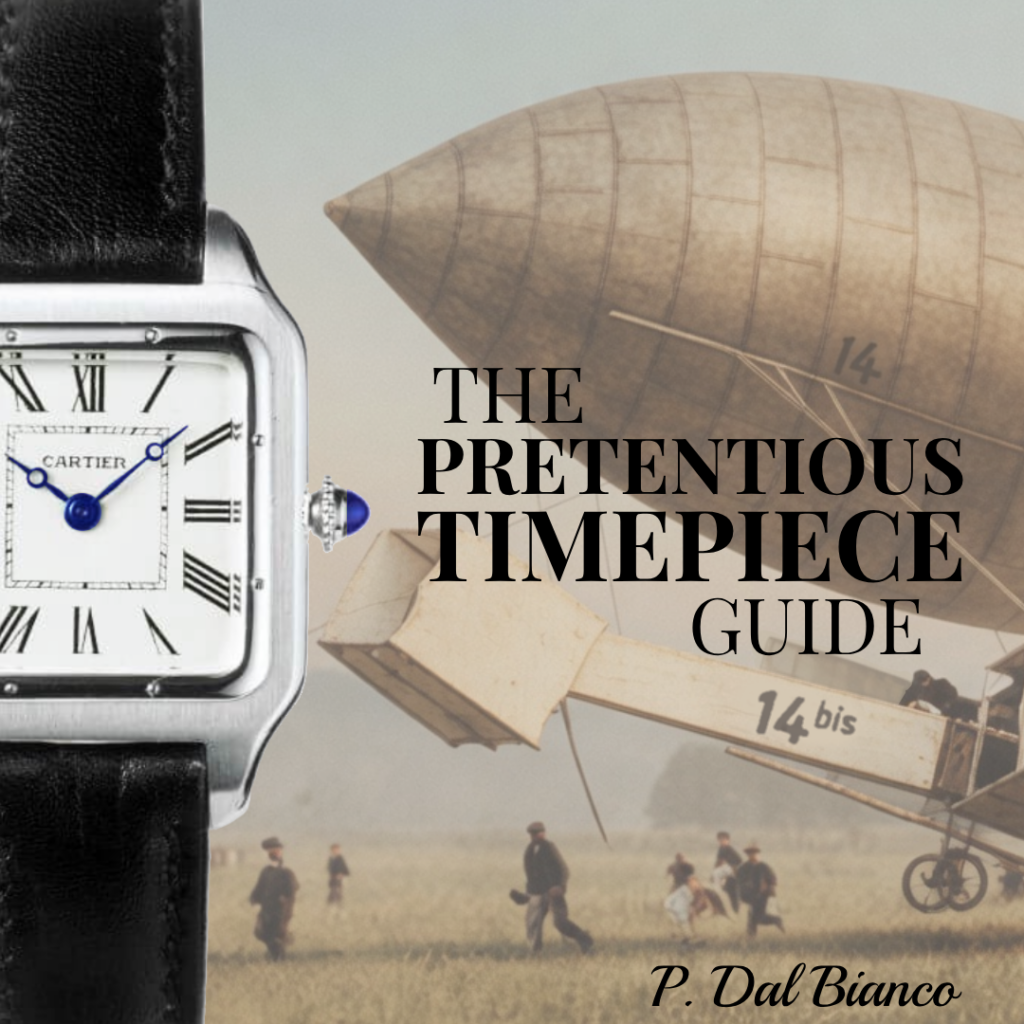
And if that feels performative, note the historical roots of wristwatches, which literally flew in the face of these rules. Over a century ago in 1904, Louis Cartier created one of the earliest modern wristwatch designs for Alberto Santos‑Dumont, a charming socialite with the steel nerved audacity to pilot his own experimental aircraft. Alberto specifically requested a wrist worn timing device to measure his flights, as he needed both hands to operate the flying machines. In other words, the first utility wristwatch was a dainty dress watch, commissioned as official pilot’s gear, moonlighting as functional jewelry for post flight celebrations. The taxonomy was compromised from day one, but perhaps those were simpler times.
Personally, I violate these rules with abandon and select watches on aesthetics alone, a fact that should raise legitimate concerns about my credibility and render this guide only marginally useful.
In a tip of the hat to Alberto’s panache, I deploy a Cartier Santos-Dumont to time the far more perilous maneuver of business class table service. Exhibiting benevolence toward the cabin crew, the Cartier adheres to proper dress watch decorum by lacking an intrusive seconds hand.
So ends the guide. Pretension delivered.
Au revoir de Paris,
P. Dal Bianco


Alberto Santos-Dumont (1873—1932)